Nordic Sustainable Development Report 2025
This is the first assessment decidated specifically to how the Nordic countries perform on the Sustainable Development Goals (SDGs). Whether you work in policy, research, civil society, or the private sector, this report helps you understand where the Nordic region is progressing, where progress is slowing, and where urgent challenges remain.
The Nordic Sustainable Development Report 2025 (NSDR) gives you a clear and accessible overview of how the Nordic countries – Denmark, Finland, Iceland, Norway, and Sweden – are progressing toward the Sustainable Development Goals (SDGs), both at home and through their impacts abroad. This report offers a comprehensive assessment of Nordic SDG performance, enabling you to understand not only where the region excels but also where significant challenges remain.
It also gives you insights on Leave-No-One-Behind in the Nordics, international spillover impacts, as well as how Nordic SDG progress aligns with the Nordic Council of Ministers’ Vision 2030.
Whether you work in policy, research, civil society, or the private sector, this report offers an in-depth, evidence-based analysis of the Northern Europe region and each of the five Nordic countries. It is designed to help you navigate the region’s strengths, identify critical gaps, and gain a deeper understanding of the dynamics shaping sustainable development in the Nordics today.
On this page, you can download the full report and a set of infographics. You will also find the key findings from the analysis, including visual summaries of SDG performance in the Nordic countries.
Key findings
- The Northern Europe region lead Europe on SDG implementation, with consistently high index scores.
- The strong results stem from long-standing social reforms and recent progress has stalled.
- Major gaps remain in SDGs 2, 12, 13, 14 and 15, linked to consumption, emissions and ecosystem pressures.
- Large negative international spillovers undermine global SDG progress.
- Nordic countries share similar SDG profiles, especially Finland, Denmark and Sweden.
- All Nordic countries perform well on Leave-No-One-Behind indicators.
- International spillovers correlate negatively with SDG performance, while Leave-No-One-Behind correlates positively.
- Nordic SDG index performance aligns partly with the results for the Nordic Council of Ministers’ 2030 vision but shows even weaker results on environmental SDGs.
- Geopolitical tensions and rising security priorities challenge SDG progress in the Nordics and globally.
The Nordic SDG Index and dashboards
The SDG Index provides an overall measure of SDG achievement based on 111 indicators. The dashboards complement the Index by identifying areas where countries are on track or where major challenges remain.
The SDG Index score for a country is a value between 0 to 100 and represents the percentage of SDG implementation. These scores can be used to monitor the development of SDG implementation over time and enable comparisons of SDG implementation in different countries.
For this Nordic assessment, the SDG Index and dashboards are drawn directly from the ESDR 2025. The Nordic SDG Index shown below is therefore a subset of the European dataset, extracted to highlight the performance of the five Nordic countries within a consistent and comparable framework.
Overall SDG performance in the Northern Europe region
The Northern Europe region has the highest average SDG Index score with 78%, significantly higher than the EU average and higher than those of all other European regions.
| European region | Average SDG Index score |
|---|---|
| Northern Europe | 78.0 |
| Western Europe | 74.1 |
| European Union | 72.8 |
| Southern Europe | 71.2 |
| Central and Eastern Europe | 70.1 |
| Baltic States | 69.6 |
In the Nordic SDG Index, Finland is in the top, followed by Denmark Sweden, Norway and Iceland.
| Nordic SDG Index rank | Country | SDG Index score |
|---|---|---|
| 1 | Finland | 81.1 |
| 2 | Denmark | 79.7 |
| 3 | Sweden | 79.4 |
| 4 | Norway | 76.2 |
| 5 | Iceland | 73.4 |
Among European countries the Nordic countries rank at the positions 1, 2, 3, 5 and 10 in the European SDG Index and have high SDG Index scores that range from 73.4 to 81.1 percent of SDG implementation.
SDG performance over time
Although the Nordic countries rank highly in the SDG Index, it is important to note that this does not result from extraordinary sustainability efforts since the launch of the UN Agenda 2030 in 2015. The high rankings of the Nordic countries are indicative of a century-long history of social reforms and strong governance, which has resulted in the current high SDG Index scores for the Nordics’ social and economic SDGs.
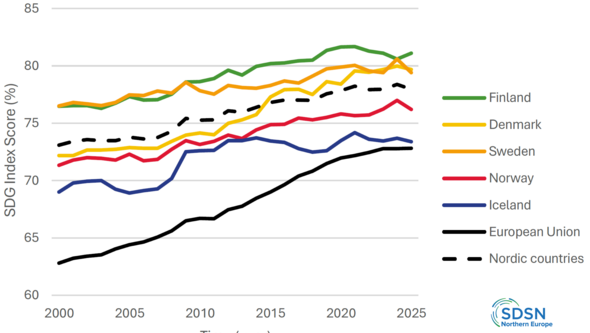
When examining the evolution of SDG performance since the early 2000s, the SDG Index scores of the Nordic countries have increased but started to level off between 2021 and 2025. In contrast, the score for the European Union increases from a lower level in 2000, but at a higher pace, and continues to increase until 2024 (Figure 1).
Where the Nordics are off track
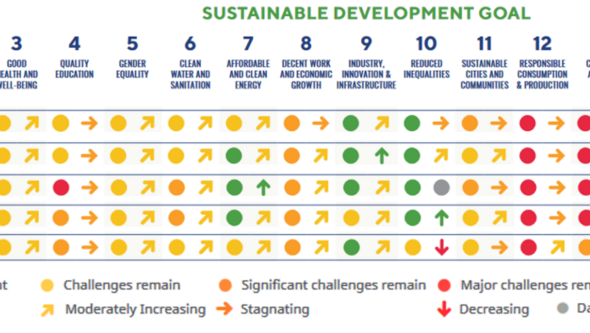
The SDG dashboard from the ESDR 2025 shows that the Nordic countries have major or significant challenges for SDG 2 (Zero hunger), SDG 4 (Quality education), SDG 12 (Responsible consumption and production), SDG 13 (Climate action), SDG 14 (Life below water), and SDG 15 (Life on land).
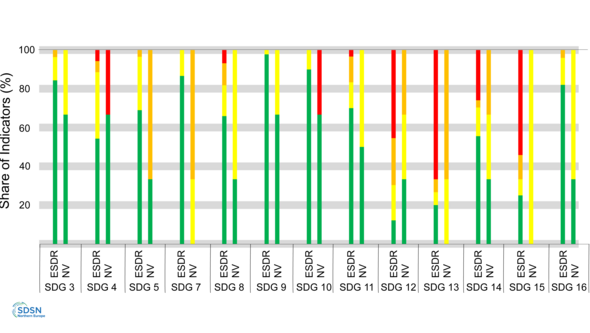
The biggest challenge is found for SDG 12, where the average Nordic SDG Index score is as low as 47.8 %. The trends for these SDGs are mostly stagnating except for moderately increasing trends for SDG 14 in Finland, SDG 15 in Denmark, and SDG 12 and SDG 14 in Sweden (Figure 2).
When analysing these challenges at the target level, it is clear that all Nordic countries have major or significant challenges for the indicators Prevalence of obesity, Human trophic level, Exports of plastic waste, Air pollution associated with imports, Imported emissions of reactive nitrogen, CO2 emissions from fossil fuel combustion and cement production, Greenhouse gas emissions embodied in imports, and Imported deforestation (Figure 3).
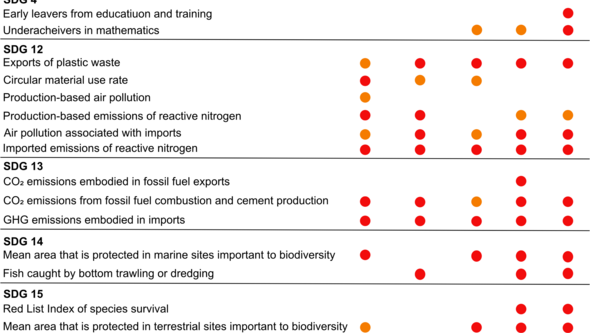
These challenges primarily relate to lifestyle choices, education, sustainable consumption and production, emissions of greenhouse gases and nitrogen, natural resource utilisation in agriculture, forestry and fisheries, and the protection of species and ecosystems.
Spillover effects and global impacts
Spillover effects play a central role in understanding the Nordic countries’ overall sustainability performance. While the responsibility to formally implement the SDGs falls on nations, the international value chains and consumption and production patterns greatly affect the success of SDG implementation.
When comparing the high SDG Index scores of the Nordic countries to their International Spillover Index scores, the gap between domestic SDG implementation and international spillovers is clear. While the SDG Index scores range from 73.4 to 81.1, the International Spillover Index scores range from 53.6 to 67.4 (Figure 5).
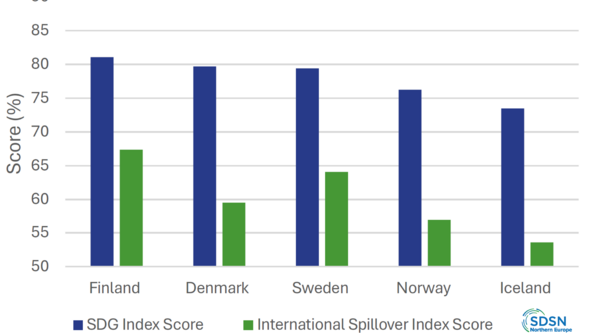
This reveals that Nordic consumption generates substantial environmental and social impacts abroad. Key challenges include:
- Imported reactive nitrogen emissions
- Greenhouse gas emissions embodied in imports
- Plastic waste exports
- Imported deforestation
- Work-related accidents and modern slavery embodied in imports
Equality and inclusion
The principle of Leave-No-One-Behind (LNOB) is central in the 2030 Agenda and calls for eradicating poverty, ending discrimination and exclusion, and reducing inequalities and vulnerabilities among people. To measure inequalities within countries, the UN SDSN has developed an LNOB index.
All Nordic countries top the LNOB Index, scoring above all other European regions. The high LNOB performance reflects strong welfare institutions, low inequality, access to essential services, and long-term social reforms. Here, Norway is in the top, followed by Finland, Iceland, Denmark, and Sweden.
| LNOB Index rank | Country | LNOB Index score |
|---|---|---|
| 1 | Norway | 86.4 |
| 2 | Finland | 84.9 |
| 3 | Iceland | 84.7 |
| 4 | Denmark | 84.4 |
| 5 | Sweden | 82.4 |
The Nordic LNOB Index ranking is the same as the European ranking in the ESDR.
The most sustainable and integrated region in the world?
The Nordic Council of Ministers’ Vision 2030 aims to make the Nordic region the most sustainable and integrated region in the world by 2030. The Nordic Region Status Report (NRSR) from 2023 acknowledges major challenges in becoming a "Green Nordic Region."
This SDG report reinforces that conclusion and suggests that the challenges may be even greater when spillover indicators are included. Because the dashboards of ESDR and the NRSR rely on different indicator sets that are not directly comparable, full alignment between them cannot be expected.
By placing these two perspectives side by side, the figure helps clarify where the Nordic region is broadly aligned across assessments, and where environmental pressures and spillover effects contribute to a lower performance on the environmental SDGs 12, 13, 14, and 15 than suggested by the NRSR alone.
COUNTRY PROFILES AND DATA
Recommended citation
Eriksson, K. M., Richardson, K., Wallbaum, H., Tomson, G., Sanchez Gassen, N., Korhonen-Kurki, K., Figueroa, M., Gylfason, T., Magerholm-Fet, A., Søgaard Jørgensen, M., and Kulmala, M. (2025). The Nordic Sustainable Development Report. Sustainable Development Solutions Network (SDSN) Northern Europe, ISBN 978-91-989640-4-2, Gothenburg, Sweden.
About SDSN Northern Europe
SDSN Northern Europe has its foundation in the global United Nations Sustainable Development Solutions Network (UN SDSN). This is a global initiative that operates under the auspices of the UN Secretary-General, mobilising the world’s largest knowledge network to drive action on the Sustainable Development Goals (SDGs) and the Paris Agreement on Climate Change.
SDSN Northern Europe was launched in 2016 and is specifically focused on advancing the SDGs and solutions within the Northern Europe region. We operate in alignment with the global SDSN's objectives while tailoring our efforts to address the unique challenges and opportunities of Northern Europe.